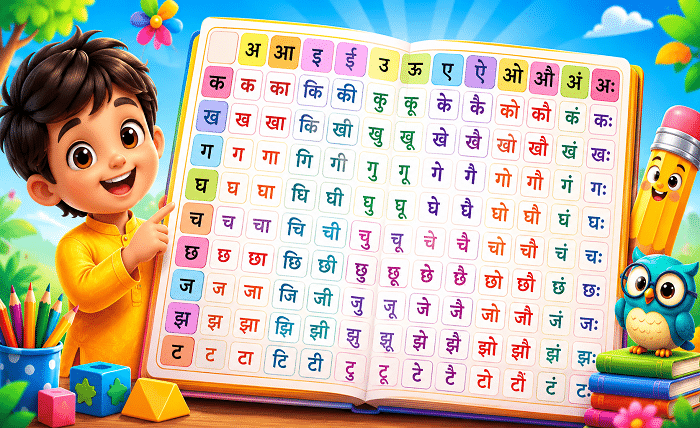
Barakhadi is one of the most important foundations for learning Hindi and Marathi languages. The term barakhadi refers to the combination of consonants and vowels that creates different syllables used in reading and writing. Students learning Hindi or Marathi are often introduced to barakhadi at an early stage because it helps them understand pronunciation, spelling, and word formation.
In simple terms, barakhadi is a chart that shows how a consonant changes when different vowel sounds are added to it. For example, the consonant “क” combines with various vowels to form का, कि, की, कु, कू, के, कै, को, and more. Learning barakhadi enables students to read words fluently and improve their language skills.
The importance of barakhadi goes beyond memorization. It serves as the building block for reading books, writing sentences, and communicating effectively in Hindi and Marathi. Without understanding barakhadi, learners often struggle with pronunciation and word recognition.
History and Importance of Barakhadi
The concept of barakhadi has been used in Indian language education for generations. Traditional schools relied heavily on barakhadi charts to teach children how vowels interact with consonants. Even today, barakhadi remains a central part of language instruction in many educational institutions.
The importance of barakhadi lies in its systematic approach to language learning. Instead of memorizing thousands of words individually, students learn the patterns of barakhadi and apply them to countless words. This method accelerates reading and writing development.
Teachers often use barakhadi to strengthen pronunciation skills because each combination demonstrates a unique sound. As a result, learners gain confidence and become more comfortable speaking the language. The educational value of barakhadi makes it an indispensable learning tool.
Understanding the Structure of Barakhadi
To fully understand barakhadi, it is helpful to break down its structure. Every barakhadi chart begins with a consonant and then displays its forms when combined with different vowel sounds. This creates a complete set of syllables that learners can practice repeatedly.
For example, the barakhadi for the consonant “क” appears as:
क, का, कि, की, कु, कू, कृ, के, कै, को, कौ, कं, कः
This sequence demonstrates how a single consonant changes with various vowels. Similar patterns exist for all consonants in the alphabet. By studying barakhadi, students learn to identify and pronounce these combinations correctly.
The structured format of barakhadi helps learners recognize recurring patterns. Once they master a few consonants, understanding the rest of the barakhadi chart becomes much easier.
Benefits of Learning Barakhadi
Learning barakhadi offers numerous benefits for language learners. One of the biggest advantages of barakhadi is improved reading ability. Since most Hindi and Marathi words are formed using consonant-vowel combinations, understanding barakhadi allows students to decode words quickly.
Another benefit of barakhadi is better pronunciation. Each syllable in barakhadi represents a specific sound, helping learners develop accurate speech patterns. This is especially useful for beginners who may struggle with unfamiliar sounds.
Writing skills also improve through barakhadi practice. As students repeatedly write the various combinations, they become familiar with letter formation and spelling conventions. Consistent barakhadi practice strengthens handwriting and boosts confidence.
Furthermore, barakhadi enhances vocabulary acquisition. Once learners understand syllable patterns, they can recognize and remember new words more effectively. This makes barakhadi an essential stepping stone toward language fluency.
Effective Methods to Learn Barakhadi
Many students find barakhadi challenging at first, but the right learning methods can make the process enjoyable and effective. One of the best ways to learn barakhadi is through daily repetition. Reading and reciting barakhadi aloud helps reinforce memory and pronunciation.
Using visual charts is another effective technique. A colorful barakhadi chart displayed at home or in the classroom allows learners to review combinations regularly. Visual learning aids improve retention and make barakhadi easier to remember.
Writing exercises also play a crucial role in mastering barakhadi. Students should practice writing each row multiple times while speaking the sounds aloud. This combination of visual, auditory, and physical learning strengthens understanding of barakhadi.
Interactive games and educational apps can make barakhadi learning more engaging. Modern digital tools often include quizzes, animations, and pronunciation guides that simplify the learning process.
Common Mistakes While Learning Barakhadi
Although barakhadi is straightforward once understood, learners often make common mistakes during the early stages. One frequent error is memorizing barakhadi mechanically without understanding the pronunciation of each syllable. This can lead to confusion when reading actual words.
Another mistake is inconsistent practice. Since barakhadi involves multiple combinations, regular revision is necessary. Learners who practice barakhadi only occasionally may struggle to retain the information.
Many students also rush through barakhadi lessons without focusing on accuracy. Pronouncing syllables incorrectly can create habits that are difficult to correct later. Careful attention to each barakhadi sound is essential.
Ignoring writing practice is another common issue. While reading barakhadi is important, writing reinforces learning and improves recall. A balanced approach to barakhadi ensures better results.
How Barakhadi Helps in Language Mastery
Mastering barakhadi is a significant milestone in language learning. Once students become comfortable with barakhadi, they can read simple words, sentences, and stories with greater ease. This foundation supports long-term language development.
The role of barakhadi in language mastery extends beyond reading. It improves listening comprehension because learners can identify familiar sound patterns. Understanding barakhadi also enhances speaking confidence by providing a clear framework for pronunciation.
As vocabulary grows, the value of barakhadi becomes even more apparent. Learners can recognize syllables within complex words and understand their structure. This skill accelerates reading speed and comprehension.
Teachers and language experts consistently emphasize barakhadi because it creates a strong linguistic foundation. Whether the goal is academic success, cultural connection, or everyday communication, barakhadi plays a crucial role in achieving language proficiency.
Modern Resources for Practicing Barakhadi
Today, learners have access to a wide range of resources for studying barakhadi. Traditional books remain popular because they provide structured lessons and exercises. Many educational publishers offer dedicated barakhadi workbooks designed for beginners.
Online videos are another valuable resource. Video lessons demonstrate pronunciation and guide learners through each barakhadi combination step by step. These tutorials are particularly useful for self-study.
Mobile applications have transformed the way students learn barakhadi. Interactive apps often include audio support, games, and progress tracking. These features make barakhadi practice more engaging and accessible.
Parents and teachers can also create personalized barakhadi activities using flashcards, worksheets, and group exercises. Combining traditional and modern resources ensures a comprehensive learning experience.
Conclusion
Barakhadi is the cornerstone of learning Hindi and Marathi. By understanding barakhadi, learners develop strong reading, writing, speaking, and pronunciation skills. The structured nature of barakhadi makes it easier to recognize word patterns and build vocabulary. Whether taught through traditional charts, books, or modern digital tools, barakhadi remains one of the most effective methods for language education. Consistent practice and proper guidance can help anyone master barakhadi and build a solid foundation for lifelong language proficiency.
FAQs
1. What is barakhadi?
Barakhadi is a chart that shows how consonants combine with vowels to create different syllables in Hindi and Marathi.
2. Why is barakhadi important?
Barakhadi is important because it helps learners improve reading, writing, pronunciation, and vocabulary skills.
3. How can I learn barakhadi quickly?
You can learn barakhadi quickly through daily practice, repetition, writing exercises, charts, and educational apps.
4. Is barakhadi used in both Hindi and Marathi?
Yes, barakhadi is widely used in both Hindi and Marathi language education as a foundational learning tool.
5. At what age should children learn barakhadi?
Children typically begin learning barakhadi during their early school years, although learners of any age can benefit from studying it.